At a glance
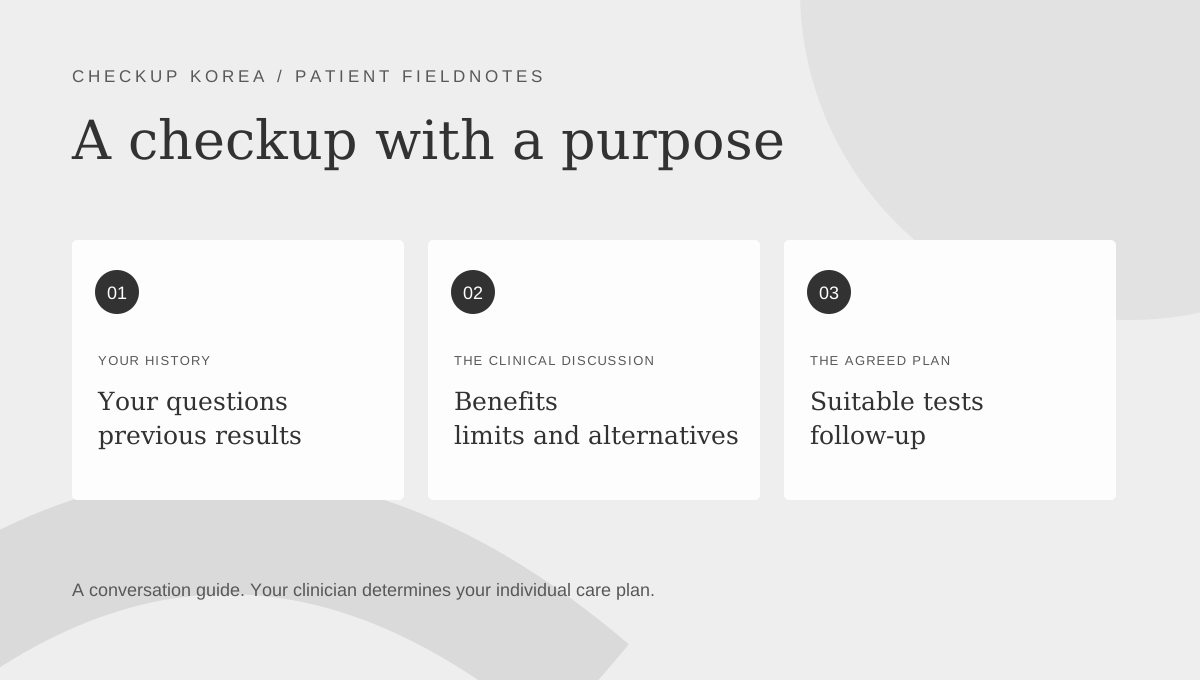
To choose a health checkup in Korea, establish your reason for attending, review relevant tests with a clinician and compare written offers with the same scope. Confirm language support, total charges, report timing and follow-up before booking.
Start with the decision you need to make
A useful health checkup in Korea starts with your medical history and ends with a clear next step. Before comparing packages, decide whether you want preventive screening while feeling well, assessment of a symptom, or monitoring of an existing condition. Those needs can lead to different appointments. A screening package is a list of services for sale; it is not a personal prescription for every test on that list.
For an international visitor, the practical question is also whether you can complete the process. The appointment, preparation, result discussion and any further assessment need to fit together. A short visit can work for some plans and be a poor fit for others. Use the questions below to build a shortlist with a clinician, then compare the provider's actual written offer. Keep the final quotation beside the test list so that the clinical and financial decisions remain connected.
Separate screening from a diagnostic appointment
Screening looks for selected conditions before symptoms appear. Age, family history and other risk factors affect which tests are appropriate. MedlinePlus describes screening as a targeted process, rather than a search for every possible illness. If you have a new symptom, tell the clinic before booking: the clinician may recommend a consultation or a different assessment instead of the standard screening route.
Write your reason for visiting in one sentence. For example, you may want to review which preventive checks are due, discuss a family history, or obtain follow-up for a previous finding. Avoid describing a persistent symptom simply as a desire for reassurance. The booking team needs the actual concern to arrange the right clinician and appointment. If your concern changes after booking, update the clinic instead of waiting until you arrive at the examination station.
Bring your previous information into the decision
Make a short health summary with diagnoses, operations, allergies, regular medicines and supplements. Add the date and result of your last relevant screening examinations. If a previous report recommended another test, include the recommendation itself rather than only your recollection of it. A photograph of a report can be a useful starting point, but a complete readable copy with units, dates and interpretation is easier to use.
Record family history as specifically as you can: which relative, which condition and approximately what age it was diagnosed. Do not guess details you do not know. Share this information through the provider's approved channel and ask whether the clinician can review it before you choose a package. This avoids spending the first part of a short visit reconstructing records that were available at home. It also gives you a more meaningful question than asking for the biggest package.
Ask what each proposed test will change
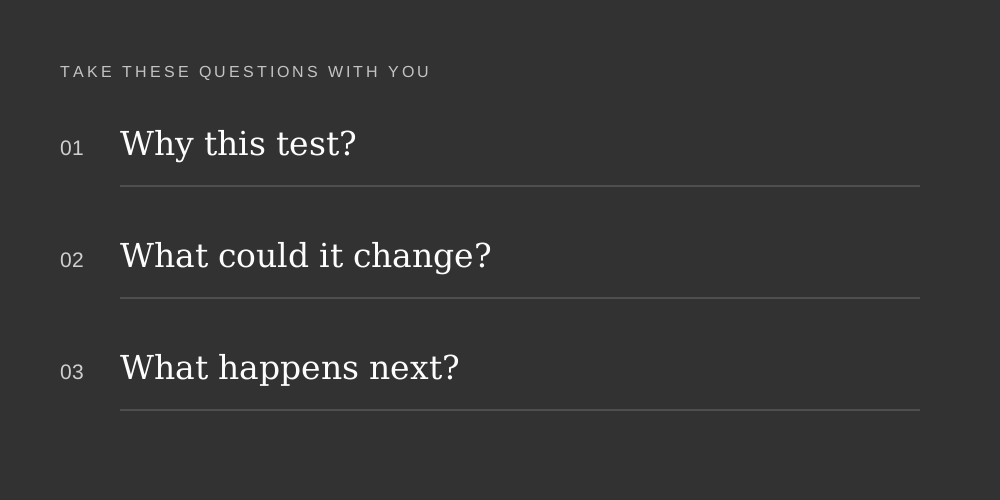
For each optional test, ask: what is it looking for, why might it be useful for someone with my history, and what happens if the result is abnormal? Follow that with a practical question: would the finding change a treatment decision or a follow-up plan? A clear answer helps you understand the test's purpose. If the answer remains vague, ask for time to consider it rather than assuming an optional item is essential.
Cancer screening can produce false-positive and false-negative results. It can also detect disease that would never have caused harm, leading to unnecessary investigation or treatment. The National Cancer Institute explains these tradeoffs as part of shared decision-making. This does not mean all screening should be avoided. It means the benefit of a particular screening test needs to be considered alongside its possible harms and its relevance to you.
Do not use scan count as a quality score
A package with more imaging is not automatically more useful. Whole-body CT screening in people without symptoms can produce incidental or misleading findings and exposes the person to radiation. The FDA's discussion of whole-body CT describes why reassurance alone is not a sufficient reason to scan every body region. That concern is different from a clinician ordering a specific scan to investigate a symptom or a defined risk.
Ask the provider to identify which imaging items are standard, which are optional and which require a doctor's decision. Request the exact name of the examination rather than a broad phrase such as advanced scan. If you already have recent images, ask whether the originals and report can be reviewed before repeating them. Keep your question neutral: you are asking the clinician to explain the plan, not trying to select or cancel medical investigations yourself.
Understand that there may be more than one screening option
Some screening decisions involve a choice between methods, with different preparation and follow-up requirements. For colorectal cancer, for example, the USPSTF describes stool-based and direct-visualisation options for appropriate patients. Its US recommendation applies to average-risk adults without symptoms, with routine screening from age 45 to 75 and more individual decisions later. That is an example of a guideline, not an automatic Korean package entitlement or an instruction for every reader.
Ask which guidance is relevant to your history and home-country care plan. If you have previous polyps, symptoms or a strong family history, do not assume an average-risk schedule applies. If you prefer a less invasive option, explain that preference and ask what the alternatives would involve. A choice is only useful when you also understand what happens after a positive or inconclusive result and whether you can arrange that next step.
Compare written offers on the same basis
Request an itemised quotation showing the examinations included, optional items and services charged separately. Ask specifically about the consultation, sedation if relevant, tissue analysis, any treatment performed during an examination, translated reports and follow-up discussion. A headline package price does not tell you how the final bill will be calculated. Do not assume an advertised price applies to your residency or insurance status without written confirmation.
Use a simple comparison sheet with one column for each shortlisted provider. Record the same questions for each: clinical review before testing, exact inclusions, appointment location, preparation, report language, result timing, additional charges and the contact for an abnormal result. Leave unanswered cells blank until clarified. This is more useful than comparing a numerical total of tests because packages can count individual laboratory components differently.
Check language support at each stage
An English website gives you a place to start your enquiry. It does not by itself establish who will interpret consent, explain medicines or discuss the report on your particular date. Ask about language arrangements for booking, the clinical consultation, each procedure and the result review. If someone else is helping you translate, agree whether you are comfortable sharing health information with that person.
Request the written preparation instructions in a language you can understand. Ask whether the final document includes the full findings or only a summary, and whether imaging and pathology reports can also be supplied. If the report will be used by a doctor in your home country, describe that need before paying. A conversation in English and an English medical record are separate services; checking both avoids a preventable gap later.
Look beyond the examination day
Before booking, ask when preliminary findings, the full report and any tissue results are expected. These may become available at different times. Find out who will review them, how you will be contacted and what to do if nothing arrives by the agreed date. Agree whether you need to remain nearby for a consultation or whether a later discussion can be arranged through the clinic's available services.
Set aside a separate budget and time allowance for a result that needs clarification. This is not a prediction that something will be wrong. It is a practical way of avoiding a plan in which every hour and every expense is already committed. If you cannot alter your departure date, say so before deciding on a procedure. The provider can then explain what arrangements are feasible and which decisions may be better made elsewhere.
A partner option to discuss: Eureka in Suwon
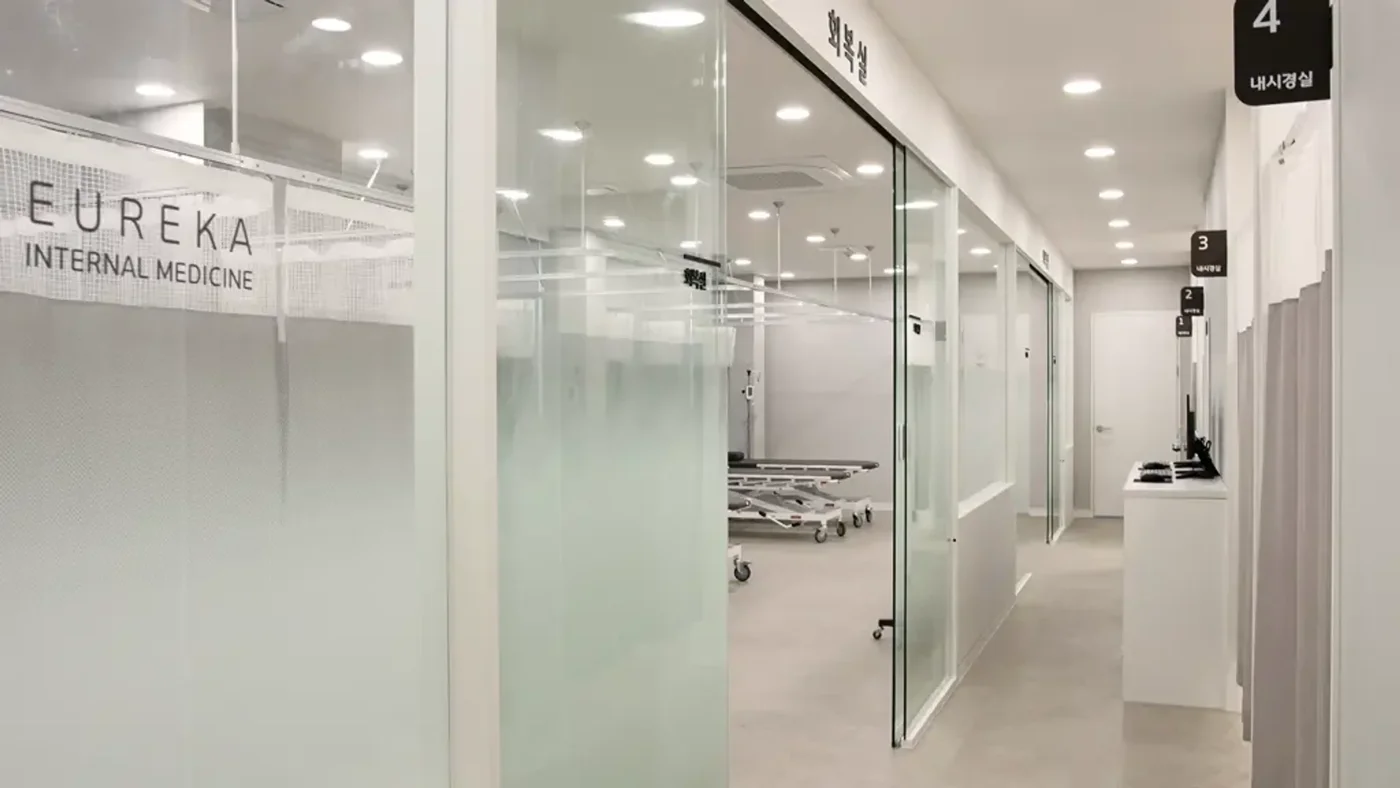
Eureka Internal Medicine Clinic / Health Checkup Centre is a listed partner in Suwon. Its international website describes comprehensive health screening, endoscopy and diagnostic imaging. It lists Dr. Suk-hwan In as an internal medicine specialist; his profile describes gastroenterology endoscopy among his areas of practice. These services make the clinic a relevant option for a discussion about a screening plan and digestive examinations when appropriate.
Review the Eureka profile and use its international website to request an itemised plan based on your history. Ask which clinician would see you and whether the tests, preparation and follow-up fit your dates. Eureka's PB commercial plan gives it promoted placement on this platform; that placement is not a judgement of clinical superiority. Provider information here comes from its own published materials and is not an independent credential assessment.
Make your shortlist actionable
Finish your enquiry with a short checklist: your main reason for visiting, previous relevant results, medicines, language needs, travel dates and the decisions you want explained. Ask for a written response identifying the proposed appointment type, included services, extra charges and result pathway. Save the reply with the quotation, not in a separate conversation that will be difficult to find at check-in.
If two plans still look similar, compare the quality of the answers to your questions rather than the length of the brochure. Can you identify who will make clinical decisions, what you must do beforehand, and who owns follow-up afterward? Those details help you organise care and make a deliberate choice. You can accept, decline or ask for clarification about optional screening after discussing its benefits and limitations with the clinician.
Common questions before you book
Can I choose a package before talking to a doctor? You can use a package as an enquiry starting point, but ask whether your history will be reviewed before the final test list is agreed. Tell the team about symptoms, earlier findings and medicines. If the booking process offers no way to provide that information, request a clinical consultation rather than trying to solve the mismatch by buying more tests.
Does a normal checkup mean I am completely healthy? No screening programme can answer every possible health question. Understand what was tested, what was not tested and the follow-up advice that applies to you. Keep using your usual health services for new symptoms and ongoing conditions. The value of the visit is a clearer, usable care plan—not a promise that future illness has been ruled out.
Common questions
What should I send in my first checkup enquiry?
State your reason for attending, travel dates, language needs and previous test dates. Ask how to share medical history securely, and request the proposed appointment type, itemised quotation and results pathway.
Is the biggest screening package the best choice?
A bigger test list does not establish greater clinical value. Ask which tests are appropriate for your history, what each result would change and what follow-up would be needed.
Partner centers to explore
These centers list related services. Confirm the exact examination and appointment with the center.
 Suwon · Yeongtong
Eureka Internal Medicine & Health Checkup Centre
Internal medicine, endoscopy and imaging in Suwon, with four named internal medicine specialists.

Dr. Suk-hwan In
Eureka Internal Medicine & Health Checkup Centre
View profile ↗Sources & further reading
Explore the partner centers
Use the directory to review relevant services and medical teams, then confirm the details directly with the provider.
Find a center