At a glance
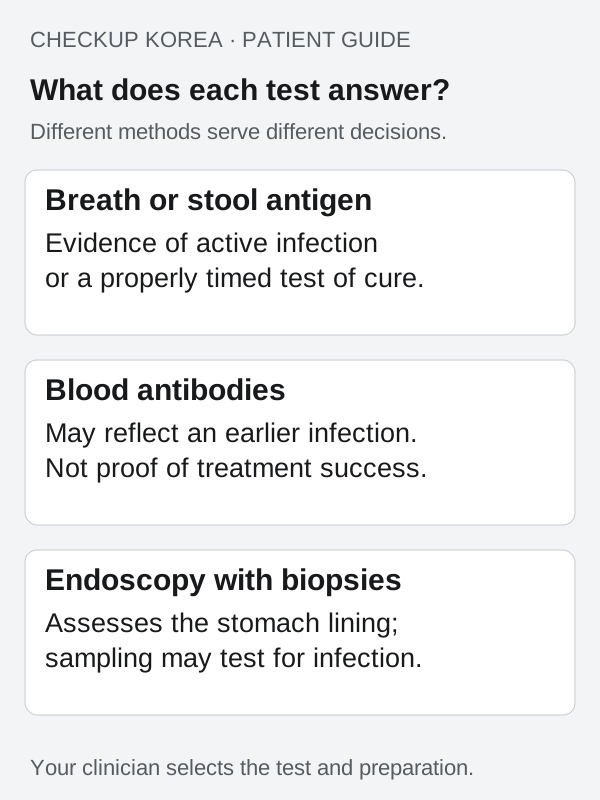
Breath and stool tests can assess active H. pylori infection; antibody blood tests may reflect past infection. Endoscopy may be needed for a separate clinical reason. Ask a clinician to select the test and medicine-related timing, and arrange a test of cure after treatment.
Choose the test around the question
H. pylori testing in Korea should answer a specific question: do you have an active infection, does a stomach problem need investigation, or has treatment cleared an earlier infection? Breath and stool tests can assess infection without endoscopy. A blood antibody result can reflect a past infection, and an endoscopy examines the stomach lining for additional reasons. These are not interchangeable checkup extras.
Before booking, say whether you have symptoms, an earlier positive result, previous treatment, or a family history that concerns you. Bring the actual report rather than a note saying “stomach bacteria positive.” The test method and date matter. This guide is for adults arranging a clinical discussion, including travelers who need to continue care after leaving Korea. It does not recommend testing every visitor or choosing antibiotics from an online checklist.
Sources: MedlinePlus: H. pylori tests; NIDDK: Diagnosing peptic ulcers
Why infection testing is different from cancer screening
H. pylori is a bacterium that can live in the stomach lining. Infection can contribute to ulcers and chronic inflammation, and is linked with certain stomach cancers. A positive infection test is not a cancer diagnosis. Likewise, a negative infection result does not replace an investigation of concerning symptoms or a clinician’s plan for an existing stomach condition.
Treatment of infection can lower gastric cancer risk in studied populations, but it does not promise that an individual will never develop cancer. If a previous biopsy found intestinal metaplasia or another change needing surveillance, keep that follow-up plan separate from the question of whether the infection has cleared. Ask the clinician to write down both decisions so that one reassuring result does not cause the other appointment to be forgotten.
Who should discuss a test rather than simply buy an add-on
Reasons to raise the question include a previous ulcer, persistent upper abdominal discomfort, relevant findings at endoscopy, certain cases of iron deficiency, or a family history of stomach cancer. These situations need a history-based assessment. Symptoms alone cannot identify the bacterium, and a relative’s diagnosis does not establish that you have the same infection.
Write a short account of what has changed: when discomfort began, whether it interrupts meals or sleep, which medicines you have tried, and whether you have been tested before. Include any previous treatment even if it happened years ago. Tell the clinic about pregnancy, allergies and other medical conditions before agreeing a plan. A consultation may be more useful than adding a test to an otherwise unrelated screening package.
Sources: American Gastroenterological Association: H. pylori
Breath test, stool test or antibody blood test?
A urea breath test detects a change in exhaled breath after swallowing a specially prepared substance. A stool antigen test looks for evidence of the bacterium in a stool sample. Both can be used in appropriate circumstances to investigate current infection or check treatment success. Ask for the exact test name on the quotation and report, not simply an item called “H. pylori screening.”
Antibody blood tests measure the immune response. Antibodies can remain after an earlier infection, so a positive result may not show current infection and is not a suitable way to prove that treatment worked. If an old checkup report lists only an antibody result, ask how the clinician will clarify its meaning before you assume you need another course of medicine.
Practical differences can matter on a short trip. For a stool test, ask where to collect the kit, how the sample must be stored and when the laboratory accepts it. For a breath test, ask whether a separate visit is needed and request its preparation instructions. Do not choose solely by which appointment is fastest; a convenient test at the wrong time may leave the original question unanswered.
Sources: MedlinePlus: H. pylori tests; NIDDK: Diagnosing peptic ulcers
When an endoscopy answers an additional question
An upper endoscopy lets the clinician inspect the esophagus, stomach and duodenum. Tissue samples can help investigate an ulcer or other findings and may be tested for H. pylori. This is a different decision from ordering a noninvasive infection test. A person can need endoscopy for a clinical reason even when a breath test is available, while another person may not need a scope just to assess infection.
If a package already includes gastroscopy, ask whether H. pylori testing is included, which method will be used and whether biopsy or laboratory fees are separate. Also ask when each result will return. The visual examination report, tissue analysis and infection result may not all be final on the day of the procedure. Knowing that in advance helps you avoid mistaking a preliminary conversation for a completed assessment.
Endoscopy also has burdens that a breath or stool test does not: preparation, possible sedation and recovery arrangements. Uncommon but important risks include bleeding, perforation and reactions to sedation. Ask why its expected benefit justifies those risks for your situation, and arrange the clinic’s required escort if sedation is planned.
Sources: NIDDK: Upper GI endoscopy
Medication history can change the testing timetable
Acid-suppressing medicines, antibiotics and bismuth can interfere with some H. pylori tests. The American College of Gastroenterology’s 2024 guidance specifies waiting at least four weeks after treatment before a test of cure, with a two-week interval off proton pump inhibitors and a four-week interval off antibiotics and bismuth to reduce false-negative results. These are guideline timing principles for a clinician to apply, not instructions to stop your medicines yourself.
Send the prescribing team the names, doses and dates of everything relevant, including proton pump inhibitors, potassium-competitive acid blockers (P-CABs), and any recent antibiotic taken for a different illness. Ask for a personalized written schedule stating the last dose only if a change is appropriate, the test date, and what to do if symptoms recur. If you cannot safely change a medicine or your travel dates do not fit, ask about another arrangement rather than quietly changing the schedule.
A positive result needs a treatment and follow-up plan
A confirmed infection should lead to a clinician-led discussion of treatment, allergies, previous antibiotic use and the plan for checking success. Korea’s 2025-revised guideline, published in 2026, addresses antibiotic resistance testing and tailored treatment. A positive breath or stool antigen test does not itself tell the doctor which antibiotics will work. The relevant treatment choices depend on more than the test name.
Bring records of earlier eradication attempts, including drug names, treatment dates and any side effects. If you cannot obtain them, describe what you remember without guessing. Ask whether resistance testing would be useful in your situation, what the available test can actually identify, and how it affects the proposed prescription. Do not reuse leftover antibiotics or copy a regimen from a previous trip. If more than one treatment has failed, ask whether specialist assessment is needed.
Sources: Korean College of Helicobacter: 2025 revised guideline, published 2026
Feeling better does not prove the infection has cleared
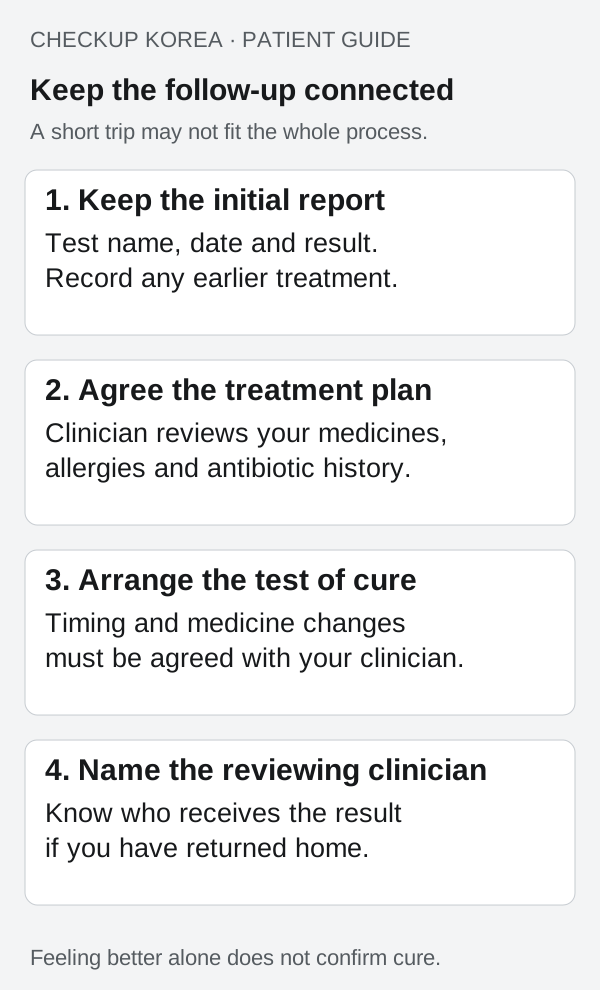
Symptoms and eradication are different outcomes. The AGA explains that confirmation testing is important after therapy; relief of discomfort alone is not proof that H. pylori has gone. Ask which clinician will order the test of cure, what method will be used and who will interpret the result. Keep that appointment in the plan even if your stomach feels normal again.
For a short visit to Korea, completing the entire process may extend beyond your departure. Before treatment starts, discuss whether follow-up testing will happen in Korea or with your usual clinician at home. Request a readable record of the initial test, prescribed medicines and completion date. Give the receiving clinician the original documents rather than only a translated summary if important detail is missing. Agree how the result will get back to the team responsible for your care.
Sources: American Gastroenterological Association: H. pylori; ACG: 2024 H. pylori guideline highlights
If a result is negative but the question remains
A negative result needs to be interpreted alongside the method, timing and preparation. If testing occurred during a medicine-related interference window, ask the ordering clinician whether the result answers the intended question or whether a correctly timed repeat is needed. Do not keep booking different commercial tests until one produces the answer you expect.
Persistent symptoms also deserve their own review. H. pylori is not the only possible explanation for digestive symptoms. Tell the clinician whether symptoms are continuing, worsening or changing after the test. Ask what the next assessment is intended to investigate and whether it needs to happen before travel. A written explanation of the next step is more useful than a collection of test reports that no one has considered together.
Sources: MedlinePlus: H. pylori tests; ACG: 2024 H. pylori guideline highlights
When to seek care instead of waiting for a checkup
Seek immediate medical attention for vomiting blood or material that looks like coffee grounds, black or tarry stools, sudden severe persistent abdominal pain, or fainting. These can be signs of an ulcer complication or another urgent problem. Do not wait for a routine H. pylori appointment, an online reply or your return flight to have them assessed.
If you are already receiving care for an ulcer and symptoms change or worsen, contact the treating service promptly. Carry your medicine list and available reports when seeking care. The urgent team needs your current symptoms and treatment history; whether a screening package includes another infection test is a separate issue.
A listed clinic to discuss digestive assessment: Eureka
Eureka Internal Medicine & Health Checkup Centre in Suwon is a relevant listed option because its official international site describes internal medicine care and gastroscopy, including assessment of gastritis and ulcers. Those documented services support a conversation about digestive symptoms and the appropriate testing route. They do not establish that every H. pylori test or resistance assay is available on every appointment date.
Review Eureka’s platform profile and its official endoscopy service page, then ask whether your visit should be an internal medicine consultation, a specific infection test, or endoscopy for an additional clinical reason. Request confirmation of the proposed method, preparation, report language and follow-up arrangements. Eureka receives promoted placement through its PB commercial plan; this is not evidence of better clinical outcomes or an individual recommendation to undergo a procedure.
Sources: Eureka international website; Eureka endoscopy services
Compare the complete process, not a single test price
Ask for an itemized quote separating consultation, infection testing, any endoscopy or tissue analysis, prescription costs and the later test of cure. Confirm whether a review of an outside report has its own fee. No single advertised package price can tell you what your particular sequence of care will cost, and a visitor should not assume Korean insurance coverage applies.
Finish with four practical answers in writing: what question the test is meant to answer, how you must prepare, when the result is expected, and who handles the next decision. If treatment is prescribed, add the follow-up testing arrangement. Keep these details with your reports so that the plan remains understandable after you leave Korea, change accommodation or see a different clinician.
- Prepare for your checkup and endoscopy
- Review Eureka’s listed profile
- Understand stomach and other cancer screening decisions
Contact the relevant partners
Review Eureka’s official endoscopy services
Partner centers to explore
These centers list related services. Confirm the exact examination and appointment with the center.
 Suwon · Yeongtong
Eureka Internal Medicine & Health Checkup Centre
Internal medicine, endoscopy and imaging in Suwon, with four internal medicine specialists and a radiology specialist.
Explore the medical teams

Dr. Suk-hwan In
Eureka Internal Medicine & Health Checkup Centre
View profile ↗
Dr. Kyung-eun Lee
Eureka Internal Medicine & Health Checkup Centre
View profile ↗
Dr. Seung-hyun Jeon
Eureka Internal Medicine & Health Checkup Centre
View profile ↗
Dr. Ji-soo Min
Eureka Internal Medicine & Health Checkup Centre
View profile ↗Sources & further reading
- MedlinePlus: H. pylori tests ↗
- NIDDK: Diagnosing peptic ulcers ↗
- National Cancer Institute: H. pylori and cancer ↗
- American Gastroenterological Association: H. pylori ↗
- NIDDK: Upper GI endoscopy ↗
- ACG: 2024 H. pylori guideline highlights ↗
- Korean College of Helicobacter: 2025 revised guideline, published 2026 ↗
- NIDDK: Symptoms and causes of peptic ulcers ↗
- Eureka international website ↗
- Eureka endoscopy services ↗
Explore the partner centers
Use the directory to review relevant services and medical teams, then confirm the details directly with the provider.
Find a center