At a glance
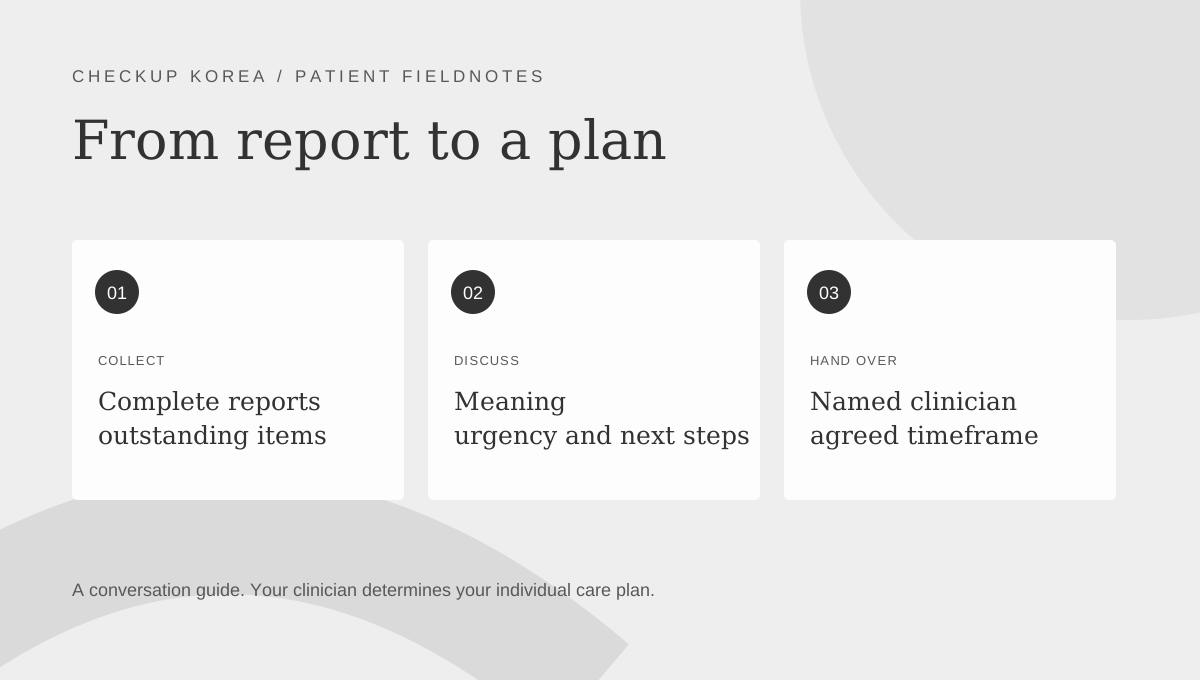
Ask a clinician to interpret your checkup results and separate urgent action, planned follow-up and routine prevention. Obtain all expected reports, including any delayed pathology, and agree who is responsible for each next step in Korea or at home.
A report is the start of the next decision
After a health checkup, the most useful question is not simply whether every number is normal. It is what the findings mean for you and what should happen next. Ask for a clinician's interpretation that separates matters needing prompt assessment, planned follow-up and routine prevention. Keep the original report alongside that explanation so another clinician can review the evidence rather than only a summary of a conversation.
For an international patient, this handover may cross countries, time zones and healthcare systems. Arrange who will review the results before you leave Korea, or before the agreed remote discussion. A test completed abroad is not automatically transferred into your medical record at home. The steps below help you close that gap without trying to diagnose yourself from coloured flags, unfamiliar abbreviations or an automated translation of a medical document.
Find out which results are still outstanding
A screening visit can generate several documents: laboratory results, imaging interpretations, an endoscopy report and, when samples were taken, a pathology report. These do not necessarily become available together. Ask the clinic for a list of expected reports and a date or time window for each. Mark an item complete only when you receive the actual document, not when someone says the overall checkup went well.
Use a simple tracker with the examination name, date performed, expected result date, contact person and whether a review has occurred. Keep this for your own use rather than sending medical details to a public planning tool. If the full report arrives but a biopsy result is missing, ask specifically about that item. Do not assume silence means a result is normal or that an incomplete bundle is the final medical record.
Read the identity and test details first
Before interpreting a number, check the name, date of birth or other identifiers on the document and the examination date. Confirm that the report belongs to you and that it relates to the intended visit. If there is an error, request a corrected copy through the provider's records process. Keep the earlier version until the clinic explains whether the change affects any clinical interpretation.
Then identify the specimen or examination, units and the laboratory's reference range. MedlinePlus explains that reference ranges and methods vary between laboratories. A value outside a listed range does not automatically establish disease, and one within it does not rule out every health problem. Ask a clinician to interpret results in context instead of matching the number to an online chart from another laboratory or country.
Ask for priorities rather than a line-by-line alarm list
A report may contain many flags without explaining which findings change care. Ask the reviewing clinician to group recommendations by urgency and purpose. You need to know what requires action soon, what needs a scheduled repeat or specialist assessment, and what can be discussed during ordinary ongoing care. Request a timeframe in words or a date where possible, rather than a vague instruction to follow up later.
Write down the reason for each proposed action. For example, is the clinician clarifying an uncertain result, comparing it with an earlier examination or planning long-term monitoring? You do not need to understand every technical detail immediately, but you should understand the decision being made. If a recommendation is unclear, repeat it back in your own words and ask whether you have understood correctly. Keep the agreed plan with the original report.
Do not equate a screening flag with a diagnosis
A positive screening result can require diagnostic testing to establish what is happening. The National Cancer Institute distinguishes a screening test from the further assessment used to diagnose cancer. False-positive and false-negative results are possible. An abnormal flag is therefore a reason to follow the recommended pathway, not a sufficient basis for concluding that you have a particular disease or for dismissing the result as meaningless.
Avoid sending only the flagged line to several online services and trying to choose the most reassuring answer. Each reviewer may lack the examination details, your history and the clinician's reasoning. Instead, gather the complete report and ask what additional information is needed. If you want another medical opinion, provide the same full records so that the second clinician can assess the actual finding rather than an isolated phrase.
Keep the procedural report and pathology together
If a biopsy or polyp removal took place, the procedure report and tissue result answer different questions. The first records what was seen and done; the pathology report records the laboratory examination of the sample. NIDDK notes that tissue results can take longer than the immediate findings discussed after endoscopy. Ask who will explain the final combination and whether it changes the original follow-up advice.
Request the examination date, procedure details and relevant images or records the next clinician may need. If more than one sample was taken, ask whether all expected results have returned. Do not infer a complete answer from a message that only mentions one sample. Keep any updated follow-up recommendation with the final pathology report so your clinician at home can see which advice was issued after all information became available.
Decide who owns the next step
A recommendation is easier to follow when someone is clearly responsible for arranging it. Ask whether the Korean clinic will book the next appointment, send a referral or simply provide a report for your usual doctor. If you are already abroad, tell the clinic where you are and what services you can access. Avoid leaving both clinicians assuming that the other has taken over.
Create a short handover note containing the finding, the recommended action, the suggested timeframe and the supporting files. Add the Korean clinic's contact details and your preferred way to be reached. Send this through the receiving clinician's approved route and confirm receipt. If no appointment has been arranged, keep the task open on your own list. An email sent, a referral received and an assessment completed are three different stages.
Obtain records that another clinician can actually use
Ask for the full report in the language needed for your follow-up, together with relevant imaging and pathology documents. An English summary may be helpful but may not contain every measurement or finding. The CDC recommends obtaining overseas medical records in English and sharing them with subsequent healthcare professionals. Tell the clinic before departure if your next appointment depends on receiving a complete set of records.
For imaging, ask the receiving clinician what format is useful. A screenshot may not substitute for the original study. Check that files open and that passwords or access instructions work before leaving the issue behind. If a download link expires, save an authorised copy securely while it is available. Keep a separate backup and avoid posting records publicly to obtain informal interpretation. You remain responsible for deciding who can see your health information.
Compare with previous results carefully
Bring earlier reports to the follow-up consultation, especially if a previous clinician was monitoring the same issue. Keep dates, units and reference ranges visible. MedlinePlus notes that preparation, medicines and other factors can affect laboratory results. The clinician needs that context before deciding whether a difference reflects a meaningful change, a testing difference or a reason to repeat an examination.
Build a chronological folder rather than manually rewriting every number into a spreadsheet. If you do create a personal summary, retain links to the originals and label it as your own transcription. Check for decimal, unit and date errors. Do not convert units from memory or delete an earlier finding because a later report appears reassuring. Your follow-up clinician can decide which comparisons are appropriate and which documents remain relevant.
Make remote communication specific
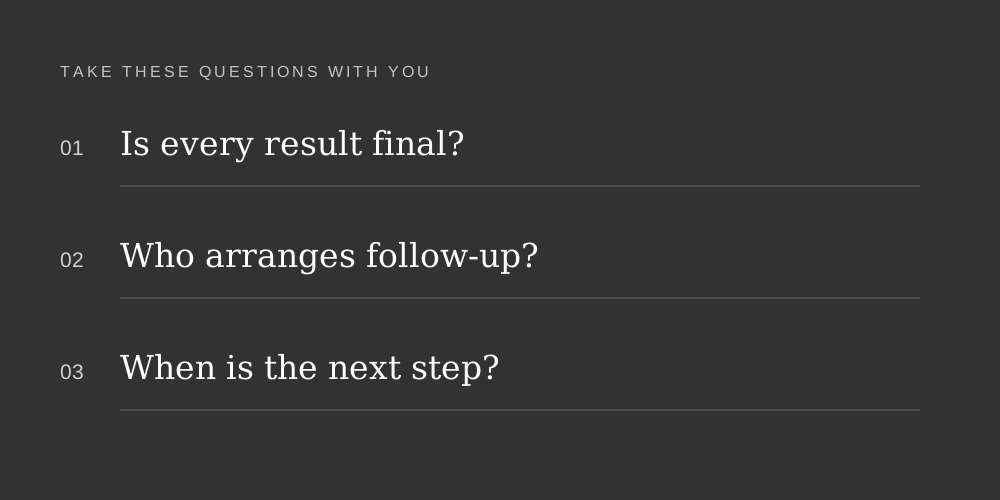
When asking the clinic a follow-up question, include the examination date and identify the report or recommendation you mean. State the question directly: whether a result is final, what timeframe was intended, or which file is needed for the next doctor. Use the clinic's approved secure channel for personal details. Avoid scattering different parts of the same medical question across social messages, email and a booking enquiry form.
Ask whether a formal consultation is needed for interpretation rather than expecting administrative staff to make clinical decisions. Confirm any fee, availability and limitations of a remote review before relying on it. Keep time-zone differences in mind when scheduling, and write the appointment time with the location or time zone. If your health situation changes, describe that change rather than continuing to discuss only the original screening result.
A partner pathway to discuss before leaving
Eureka Internal Medicine Clinic / Health Checkup Centre lists both screening and chronic disease management on its international website. That combination makes it relevant to ask how findings from a checkup are reviewed and whether continuing assessment can be arranged. Dr. Suk-hwan In is listed as an internal medicine specialist. His availability and the exact follow-up arrangements need to be agreed for your visit.
Use the clinic's international website through its Checkup Korea profile to ask who will interpret the final reports, what records you will receive and how recommendations can be handed to your usual doctor. Eureka receives promoted placement through its PB commercial plan; this does not establish that it is clinically preferable to another suitable provider. The recommendation is based on its published service scope, not a guarantee of remote care or a particular outcome.
Turn the report into a realistic calendar
After the clinician explains the findings, record the actions you agreed to take and the dates for them. This may include obtaining a missing report, attending a consultation or arranging a recommended repeat test. Distinguish a booking deadline from the date a test is due. Add a reminder to confirm completion, not just to send the first enquiry. Keep optional decisions separate from actions the clinician considers time-sensitive.
At the next appointment, bring the plan as well as the medical documents. Ask the clinician to reconcile any differing recommendations and explain which schedule you should now follow. If cost, travel or access makes an instruction difficult, say so. A workable plan should account for those constraints rather than depend on an appointment you cannot attend. Do not change prescribed treatment based only on the screening report or an internet interpretation.
Know when routine follow-up is not enough
If you develop severe symptoms, seek appropriate urgent care rather than waiting for the next scheduled report discussion. After endoscopy, the treating team's discharge instructions should identify warning signs; severe or worsening pain, breathing problems, significant bleeding or vomiting blood should not be handled as an ordinary administrative enquiry. Take your procedure information and medicine list with you so the assessing team can understand what happened.
For routine results, close the process only when you have received the expected documents, understood the interpretation and agreed the next steps. A normal report still has a defined scope: it describes the examinations performed at that time. Keep your usual preventive and ongoing care arrangements, and seek assessment for new symptoms. The practical goal is continuity—a checkup that adds useful information to your care instead of becoming a disconnected file from a trip.
Common questions
Does an out-of-range blood result always mean disease?
No. Laboratory ranges vary, and results must be interpreted alongside your history and other findings. Ask the reviewing clinician what the result means and whether further testing is needed.
Can I assume no message means my results are normal?
No. Keep a list of expected reports and their agreed delivery dates. Contact the clinic if a result is missing, especially when biopsy or pathology results are separate from the initial report.
Partner centers to explore
These centers list related services. Confirm the exact examination and appointment with the center.
 Suwon · Yeongtong
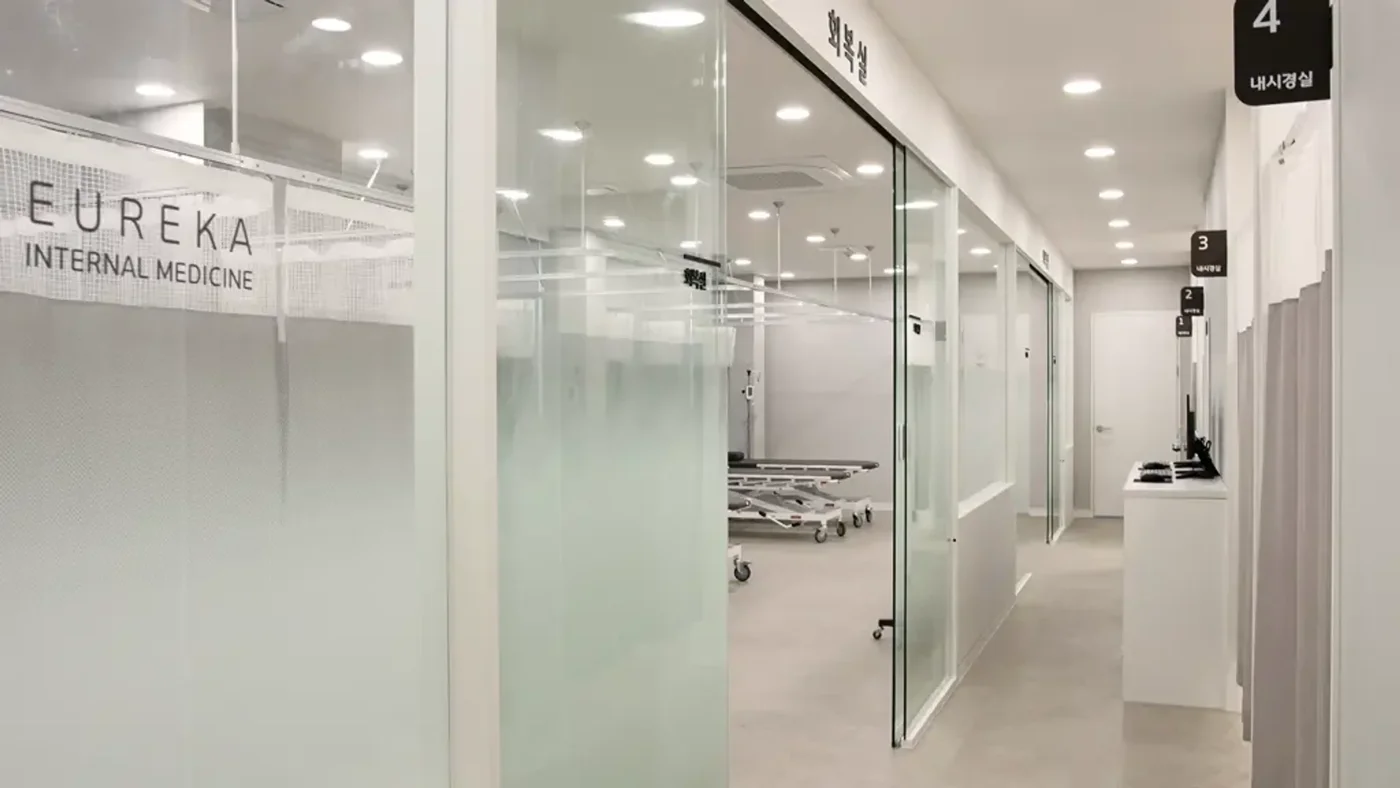
Eureka Internal Medicine & Health Checkup Centre
Internal medicine, endoscopy and imaging in Suwon, with four named internal medicine specialists.

Dr. Suk-hwan In
Eureka Internal Medicine & Health Checkup Centre
View profile ↗Sources & further reading
Explore the partner centers
Use the directory to review relevant services and medical teams, then confirm the details directly with the provider.
Find a center