At a glance
High ALT, AST or GGT does not diagnose a particular liver disease. A clinician interprets the full panel with your history, earlier tests and symptoms, then chooses a focused next step. Repeat blood tests, hepatitis testing, ultrasound or fibrosis assessment may answer different questions; none is automatically needed for every flag.
An abnormal enzyme is a clue, not a diagnosis
High ALT, AST or GGT on a Korean health checkup does not, by itself, identify a liver disease or measure how much healthy liver remains. These blood tests help a clinician decide which explanation to investigate. The useful next step is a focused review of the complete liver panel, your previous results and your medical history, rather than choosing a treatment from the flagged number.
A report may group these measurements under liver function, LFTs or a liver panel. The label can be confusing: some measurements mainly signal possible cell injury, while others help assess functions the liver performs. A flag is a reason to ask what it means in your situation. Feeling well does not settle the question, and a result outside the laboratory range does not automatically mean that you need medicine.
Sources: MedlinePlus: liver function tests
ALT and AST provide different clues
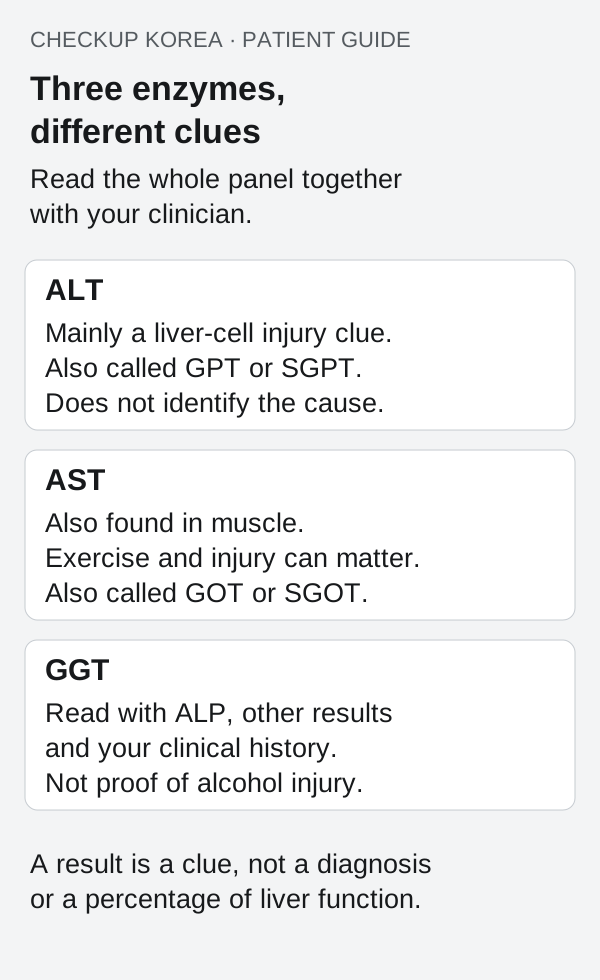
ALT, or alanine aminotransferase, is found mainly in the liver. When liver cells are injured, ALT can enter the blood. You may also see GPT or SGPT on an older report. A raised ALT gives the doctor a reason to consider liver injury, but it does not distinguish fatty liver, a viral infection, a medicine effect or another cause on its own.
AST, or aspartate aminotransferase, is also present in muscle and other tissues. Its older names include GOT and SGOT. Exercise and muscle injury can affect interpretation, so mention unusually strenuous training or recent muscle symptoms when the doctor reviews the result. That history is context, not proof that a high AST is harmless. If AST and ALT are different, ask how the whole pattern changes the assessment rather than diagnosing yourself from their ratio.
GGT is not a stand-alone alcohol test
GGT may be written as gamma-GT, GGTP or GTP. It can rise with liver or bile-duct problems, but it cannot identify the cause by itself. Alcohol, some medicines and other factors can influence it. A raised GGT does not establish that alcohol caused the result, and it should not be used to label someone’s drinking history.
One useful role for GGT is helping interpret alkaline phosphatase, usually abbreviated ALP. ALP can come from the liver or bone; the combination of ALP and GGT helps the clinician assess a possible liver or bile-duct source. If only GGT is flagged, ask whether the rest of your results and your history justify further investigation. Do not assume that an isolated flag demands an expensive scan, or dismiss it without the clinical discussion.
Why the rest of the liver panel matters
A doctor looks for a pattern rather than counting the red marks. Predominantly raised ALT and AST suggest a different assessment from a pattern dominated by ALP. Bilirubin, the substance associated with jaundice when it builds up, provides another part of the picture. Patterns guide further testing; they do not make a diagnosis without the clinical context.
Albumin is a protein made by the liver. Prothrombin time, often reported with INR, relates to blood clotting. These can help assess liver function, although other conditions and some medicines also affect them. They may not all be included in a basic screening package. Ask which additional measurements are actually needed, why they matter and whether the clinician is concerned about injury, impaired function, or both. The height of ALT alone is not a reliable measure of the extent of liver damage.
Sources: American College of Gastroenterology: abnormal liver chemistries guideline summary
Read the laboratory range before comparing numbers
Keep the units and reference range beside each result. Laboratories can use different methods and ranges, so a Korean report and a report from the United States may not have identical cutoffs. A small change between laboratories should not be interpreted as improvement or deterioration without checking how the measurements were made. If repeat testing is planned, ask whether using the same laboratory would make comparison easier.
Bring the earlier report rather than only remembering that your liver tests were normal. The date, actual values and laboratory details help the clinician assess whether the finding is new or persistent. Ask what the doctor considers meaningful for you, rather than using a universal normal-ALT number found online. The printed range is part of interpretation, not a complete assessment of liver health.
Repeating the test should answer a specific question
A repeat sample may help confirm a finding or show how it changes. It should not become an endless cycle of repeating the same panel without considering the cause. British Society of Gastroenterology guidance emphasizes investigating unexplained abnormalities rather than assuming that a mild result will disappear. The urgency and next tests depend on the pattern, symptoms and history, not just how far a value sits outside its range.
Ask what the repeat is intended to establish and whether any investigation should happen at the same time. Depending on the findings, the doctor may consider tests for viral hepatitis, iron-related disorders or other causes, and may recommend ultrasound. These are possible clinical steps, not a list for everyone to purchase. Before leaving the consultation, agree who reviews the new sample and what happens if it remains abnormal. There is no single repeat-testing interval appropriate for every abnormal liver result.
Sources: AASLD: how to approach elevated liver enzymes, January 2025; British Society of Gastroenterology: management of abnormal liver blood tests
Hepatitis screening needs the actual test names
ALT and AST are not tests for hepatitis B or C infection. If your doctor recommends viral testing, check which tests were performed previously. For U.S. adults, CDC recommends an initial hepatitis B triple panel consisting of HBsAg, anti-HBs and total anti-HBc. These markers answer different questions about current infection, past exposure and immunity. A result described only as hepatitis B antibody does not tell you which marker was measured.
For hepatitis C, an antibody result and an RNA result are different. A reactive antibody can reflect past or current infection; RNA testing is used to establish current infection. Recent possible exposure can change the testing approach. Tell the doctor when any exposure occurred rather than relying on a previous negative result. Bring the original hepatitis report and vaccination record if available, and ask the reviewing clinician to explain the combination of markers before drawing conclusions.
Sources: CDC: clinical testing and diagnosis for hepatitis B; CDC: clinical screening and diagnosis for hepatitis C
Fatty liver on ultrasound does not explain everything
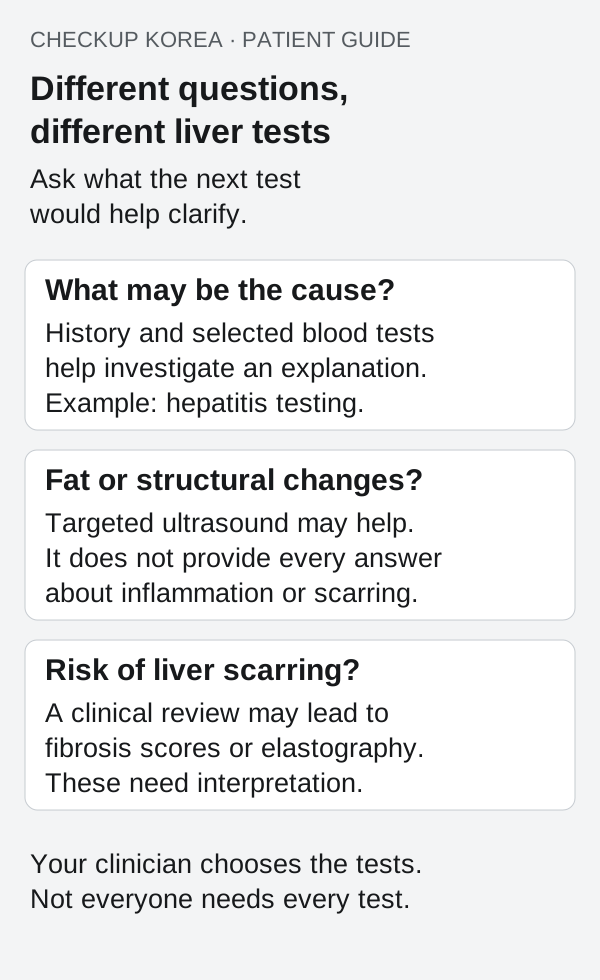
An ultrasound may identify fat in the liver. That can be relevant to raised enzymes, but the clinician still needs to consider other possible explanations. Fat in the liver, inflammation and scarring are different findings. A routine ultrasound cannot reliably supply all three answers, and an imaging phrase such as fatty change is not the same as a complete assessment of disease severity.
Ask what the proposed image is intended to clarify. Is the doctor looking for fat, a bile-duct problem or another structural finding? If you already had imaging, bring its report so the next clinician can see exactly what was examined. A request for a liver ultrasound and a request for a liver-stiffness measurement are not interchangeable. Confirm the examination name before booking, rather than assuming that every abdominal scan includes an assessment of scarring.
When scarring assessment becomes a separate question
Metabolic dysfunction-associated steatotic liver disease, abbreviated MASLD, is a term you may see for liver fat associated with cardiometabolic risk factors. Older records often use NAFLD. When MASLD is suspected, current European guidance supports a stepwise assessment of fibrosis, meaning scarring, using blood-based scores and, when indicated, tests such as elastography. This is more informative for fibrosis than ALT and AST alone.
FIB-4 is one commonly used score calculated from age, AST, ALT and platelet count. It estimates risk; it does not diagnose a fibrosis stage. Age affects its interpretation, and AASLD advises that FIB-4 should not be used during acute illness. An online score still needs clinical interpretation. Elastography measures liver stiffness, which can also be affected by factors other than scarring. Normal ALT does not reliably exclude significant fibrosis. Ask whether you need fibrosis assessment and what the result would change, rather than requesting every available test.
Sources: EASL–EASD–EASO: 2024 clinical practice guidelines on MASLD; AASLD: practice guidance on fatty liver assessment, 2023
Bring a medicine timeline, and avoid a liver cleanse
List prescriptions, nonprescription pain medicines, herbal preparations and dietary supplements, including products you stopped recently. Include names, doses when known, and start and stop dates. Bring a photograph of the packaging for an unfamiliar product. Also describe alcohol use plainly, including amounts and recent changes. A short timeline is more useful for this discussion than a list that leaves out products you do not consider medicines.
Do not start a liver detox or supplement to lower the number before the next blood draw. Johns Hopkins Medicine notes that liver-cleansing claims lack adequate clinical evidence and that some supplements can injure the liver. Do not stop prescribed treatment on your own either. Ask the prescribing clinician whether any product should be changed and how that decision fits the investigation. The goal is to identify the cause, not temporarily make the report look better.
Sources: MedlinePlus: ALT blood test; AASLD: how to approach elevated liver enzymes, January 2025; Johns Hopkins Medicine: liver detox claims and supplement risks
A listed clinic for a liver-focused consultation
Eureka Internal Medicine & Health Checkup Centre in Suwon is a relevant Checkup Korea listing to consider. Its international website lists health checkups and diagnostic ultrasound. Its internal medicine page specifically describes liver disease care using medical evaluation, laboratory testing and imaging. Those services make it reasonable to enquire about a focused review of abnormal liver blood tests rather than purchasing another broad screening package.
Review the Eureka profile and its official international website, then ask whether an internal medicine doctor can assess your existing ALT, AST and GGT results. Confirm the consultation language, which tests can be arranged, and how referral works if specialist assessment is needed. The published services do not establish that elastography or every hepatitis test is available. Eureka has promoted placement through its PB commercial plan on Checkup Korea; that placement does not establish better clinical outcomes. This recommendation is based on the relevant published service scope.
Sources: Eureka Internal Medicine Clinic: international website; Eureka Internal Medicine Clinic: internal medicine and liver disease care
Make a focused plan for Korea and home
If you are leaving Korea soon, make the liver question explicit before paying for extra tests. Ask whether the proposed investigation can return in time for a medical review, and whether it would be more practical to complete part of the assessment with your usual clinician. Request separate costs for the consultation, laboratory work, imaging and results discussion. A package price does not show which of those steps is included.
Leave with the suspected explanation, the uncertainties still being investigated and the next action in writing. For this particular handover, keep the full liver panel, platelet count if used for a fibrosis score, hepatitis markers and any liver imaging report together. Name the clinician who will compare follow-up results. If the instructions simply say repeat liver tests, ask which tests, when, and who will explain the result. A lower number is useful information, but the reviewing doctor still needs to decide whether the original question has been resolved.
Sources: British Society of Gastroenterology: management of abnormal liver blood tests; AASLD: practice guidance on fatty liver assessment, 2023
Symptoms that should not wait for a routine report review
New yellowing of the eyes or skin needs urgent medical assessment. Dark urine or pale stools can accompany jaundice. Do not wait for a scheduled checkup discussion to report these changes. If jaundice occurs with sudden confusion, severe abdominal pain or fever, seek emergency care. Vomiting blood also requires emergency attention.
A markedly abnormal result may need prompt attention even when you feel well, so follow the clinic’s urgency instructions. If you were told to seek immediate assessment, do not postpone it to finish a holiday or wait for a flight home. Bring the report and medicine list to the assessing team. These warning signs guide when to seek care; they cannot identify the diagnosis.
Sources: AASLD: how to approach elevated liver enzymes, January 2025; NHS: jaundice in adults; Healthdirect Australia: jaundice and emergency symptoms
Common questions
Does a high GGT mean I drink too much alcohol?
No. GGT is not specific to alcohol-related disease. A clinician considers alcohol history, medicines, other results and symptoms before deciding what the finding means.
Can exercise affect AST?
Yes. AST also comes from muscle, and exercise can affect the result. Tell the doctor about strenuous activity, but do not use that detail to dismiss an unexplained abnormality.
Does a normal ALT rule out liver scarring?
No. Significant fibrosis can be present with normal aminotransferases. Whether you need a separate fibrosis assessment depends on your history and the rest of the evaluation.
Should I book another full checkup to investigate one liver flag?
Ask for a focused clinical review first. The doctor can identify which existing information is usable and which further tests would answer the liver question. A larger package is not automatically a better investigation.
- Eureka Internal Medicine & Health Checkup Centre profile
- Understanding checkup results and follow-up
- Ultrasound and other imaging: purposes and limits
- Planning a Korea checkup from the United States
Contact the relevant partners
Eureka internal medicine and liver disease care
Partner centers to explore
These centers list related services. Confirm the exact examination and appointment with the center.
 Suwon · Yeongtong
Eureka Internal Medicine & Health Checkup Centre
Internal medicine, endoscopy and imaging in Suwon, with four internal medicine specialists and a radiology specialist.
Explore the medical teams

Dr. Suk-hwan In
Eureka Internal Medicine & Health Checkup Centre
View profile ↗
Dr. Kyung-eun Lee
Eureka Internal Medicine & Health Checkup Centre
View profile ↗
Dr. Seung-hyun Jeon
Eureka Internal Medicine & Health Checkup Centre
View profile ↗
Dr. Ji-soo Min
Eureka Internal Medicine & Health Checkup Centre
View profile ↗Sources & further reading
- MedlinePlus: liver function tests ↗
- MedlinePlus: ALT blood test ↗
- MedlinePlus: AST test ↗
- MedlinePlus: gamma-glutamyl transferase (GGT) test ↗
- MedlinePlus: how to understand laboratory results ↗
- AASLD: how to approach elevated liver enzymes, January 2025 ↗
- British Society of Gastroenterology: management of abnormal liver blood tests ↗
- NIDDK: diagnosis of fatty liver disease ↗
- EASL–EASD–EASO: 2024 clinical practice guidelines on MASLD ↗
- AASLD: practice guidance on fatty liver assessment, 2023 ↗
- CDC: clinical testing and diagnosis for hepatitis B ↗
- CDC: clinical screening and diagnosis for hepatitis C ↗
- Johns Hopkins Medicine: liver detox claims and supplement risks ↗
- NHS: jaundice in adults ↗
- Healthdirect Australia: jaundice and emergency symptoms ↗
- Eureka Internal Medicine Clinic: international website ↗
- Eureka Internal Medicine Clinic: internal medicine and liver disease care ↗
- American College of Gastroenterology: abnormal liver chemistries guideline summary ↗
Explore the partner centers
Use the directory to review relevant services and medical teams, then confirm the details directly with the provider.
Find a center