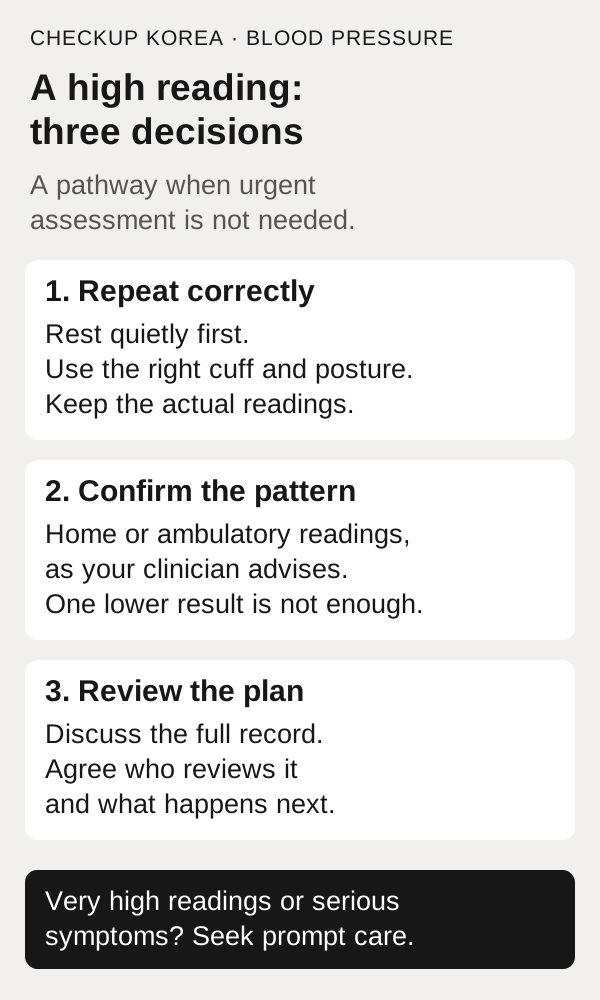
At a glance
Ask for a properly repeated blood pressure measurement and a clinician-led confirmation plan, often using home readings or 24-hour ambulatory monitoring. One high checkup result does not automatically establish long-term hypertension. Very high readings or concerning symptoms need prompt care rather than a routine monitoring schedule.
One high reading is a reason to check, not a complete diagnosis
If high blood pressure is found at your Korea checkup, ask for a properly repeated measurement and a clear plan for deciding whether the elevation persists outside the clinic. A single result can be affected by the measurement conditions. It should not be ignored, but it does not automatically establish long-term hypertension. Very high readings or concerning symptoms need a different, more urgent response, described below.
For adults without an existing hypertension diagnosis, the US Preventive Services Task Force recommends confirming an elevated office measurement outside the clinical setting before starting routine treatment. That might involve a home blood pressure record or an ambulatory monitor. If you already take blood pressure medicine, tell the doctor: this is a treatment review, not first-time screening. Keep taking prescribed medicine unless your treating clinician gives you different instructions.
Sources: USPSTF: hypertension screening in adults; American Heart Association: home blood pressure monitoring
When not to wait for a home-monitoring plan
A systolic reading of 180 mmHg or higher, or a diastolic reading of 120 mmHg or higher, needs prompt attention. If it occurs with chest pain, breathlessness, new weakness or numbness, difficulty speaking, vision changes or another severe new symptom, seek emergency help immediately. Do not wait to collect a week of readings or see whether it settles. Call 119 for an ambulance in Korea, or 911 in the United States. Serious symptoms warrant emergency assessment even if your blood pressure is below those numbers.
If you feel well but see a very high reading, repeat it after at least one minute and contact a healthcare professional promptly if it remains very high. Tell clinic staff immediately if you are still at the center. Do not take an extra dose to lower it yourself. Pregnancy and the period after birth have different risks and thresholds: report a raised reading promptly to your maternity team rather than relying on this adult screening pathway.
Sources: American Heart Association: when very high blood pressure needs urgent care; NICE: diagnosing and managing hypertension in adults; UK government: emergency services in South Korea; CDC: high blood pressure during pregnancy
Ask for a fair repeat measurement
Before a nonurgent repeat, explain whether you hurried to the appointment, recently exercised, smoked or had caffeine. These can affect the result. Sit quietly for at least five minutes with your back supported, feet flat and legs uncrossed. The cuff belongs on your bare upper arm, with the arm supported around heart level. Avoid talking or using your phone during the measurement. The cuff must fit your arm; a small cuff is not a better fit simply because it closes.
Ask staff to record the repeat, not just tell you that it improved. Keep the actual systolic and diastolic numbers, the arm used and the time. If the first measurement was taken over clothing or immediately after walking, note that context without deleting it from the record. A better repeat helps interpretation, but the clinician still decides whether more readings are needed. The purpose is to measure usual resting pressure accurately, not to produce a passing number for the report.
Sources: CDC: measuring your blood pressure; American Heart Association: home blood pressure monitoring
White-coat hypertension needs evidence, not a guess
White-coat hypertension describes blood pressure that is high in the clinic but not high on appropriate measurements outside it. Sustained hypertension is high in both settings. The reverse discrepancy also occurs: masked hypertension means the clinic result looks acceptable while out-of-office pressure is raised. These patterns explain why the setting of a measurement matters, not just the number.
Feeling anxious does not prove that a high reading is only a white-coat effect. Likewise, one reassuring reading in your hotel does not settle the question. Ask whether a structured home record or ambulatory monitoring would best resolve the difference. Bring earlier readings if you have them, including those that were higher than expected. If the doctor confirms a white-coat pattern, agree when to recheck it rather than treating it as a lifetime clearance. Out-of-office monitoring can also help review an apparent loss of control in someone already taking treatment.
Sources: USPSTF: hypertension screening in adults; Korean Society of Hypertension: highlights of its 2026 guidelines
Choose a monitor that gives the clinician usable evidence
For ordinary home monitoring, use a validated automatic upper-arm cuff device with a cuff sized for your arm. The American Heart Association recommends this approach and advises having a healthcare professional check your technique and the monitor. A brand name or an attractive app is not the same as evidence that a particular model has been validated. Ask your clinician or pharmacist to help identify a suitable model if you are unsure.
If you already own a monitor, bring the model details and cuff-size range to the appointment; bringing the device itself can be useful. Do not replace it solely because you are traveling. A phone camera estimate or smartwatch reading should not substitute for the clinician-requested cuff measurements used to confirm a diagnosis. If a cuff is painful, repeatedly fails or cannot fit your arm, ask for a workable alternative rather than collecting a record that neither you nor the doctor can trust.
Sources: American Heart Association: home blood pressure monitoring; American Heart Association: 2025 high blood pressure guideline summary
Agree a recording schedule before measuring at home
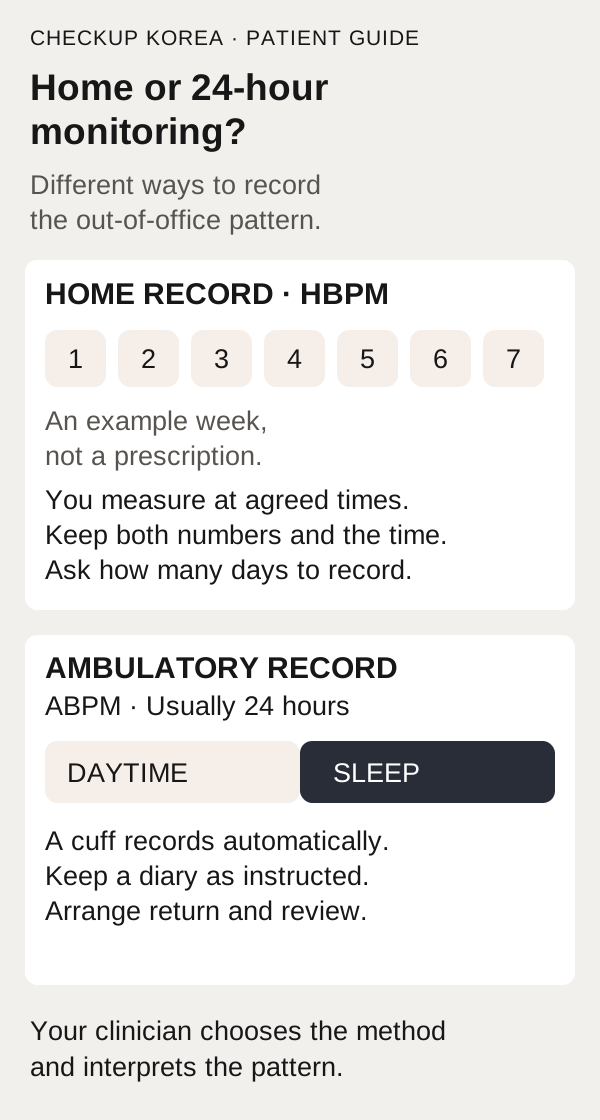
Home blood pressure monitoring means a planned series, not occasional checks when you feel worried. Ask which arm to use, what times to measure and how many days are needed. One commonly used diagnostic schedule, described by NICE, takes two seated readings at least one minute apart, morning and evening, for at least four days and ideally seven. In that protocol, the first day is excluded when calculating the average. Your clinician may use a different protocol, so agree it before starting.
Keep every reading in the original record, even if the clinician later excludes some from the calculation. Record the date, local time, both numbers and any symptoms or unusual circumstances. If you take medicine, ask how measurement times should relate to the prescribed schedule; do not delay or skip a dose just to collect a reading. Use the device memory or a simple written log, and send it through the clinic’s secure channel. Repeatedly testing until a lower number appears makes the record less useful.
Sources: NICE: diagnosing and managing hypertension in adults
What a 24-hour ambulatory monitor adds
Ambulatory blood pressure monitoring, often shortened to ABPM, uses an arm cuff connected to a portable recorder. It takes measurements automatically during daily activities and sleep, usually over a 24-hour period. Unlike a home diary, it can show what happens overnight. The clinician reviews the pattern and averages rather than treating each cuff inflation as a separate diagnosis. ABPM is also different from a Holter ECG monitor, which records heart rhythm.
Ask the service how to keep the device dry, what to do during inflation and what to record in its diary. A standard ambulatory monitor should not be worn in a bath, shower or swimming pool. You will normally need to return the equipment for its recording to be downloaded. The cuff may disturb sleep or cause temporary discomfort, and the team needs to know if much of the recording failed. Arrange the fitting, return and results review around your itinerary before accepting the test.
Sources: Shrewsbury and Telford Hospital NHS Trust: ambulatory blood pressure monitoring; USPSTF: hypertension screening in adults
Why US and Korean reports may use different labels
Blood pressure is reported in millimeters of mercury, written mmHg. The top number is systolic and the bottom is diastolic. The 2025 US AHA/ACC framework calls 130–139 systolic or 80–89 diastolic stage 1 hypertension. The 2026 Korean Society of Hypertension guidance retains an office hypertension definition of at least 140 systolic or at least 90 diastolic. A label can therefore differ even when the actual measurement is identical.
The setting matters too. NICE uses a clinic threshold of 140/90 and an average home or daytime ambulatory threshold of 135/85 for diagnostic confirmation. These are examples of guideline criteria, not a personal treatment instruction. Ask which framework the clinician is applying and whether the number being discussed is a clinic reading, home average or 24-hour average. A diagnostic cutoff and a treatment goal are different decisions. Give your doctor at home the actual numbers and monitoring method, not just a translated word such as borderline.
Sources: NICE: diagnosing and managing hypertension in adults; Korean Society of Hypertension: highlights of its 2026 guidelines; American Heart Association: 2025 high blood pressure guideline summary
What the review should decide beyond the number
Once the measurement pattern is clearer, the clinician considers your overall risk and whether other assessment is needed. Previous cardiovascular disease, diabetes, kidney disease and your current medicines can affect the plan. A doctor may review relevant blood and urine results or investigate a possible underlying cause. This does not mean that every person with a single elevated reading needs an extensive scan package.
Ask what each proposed investigation would change: is it confirming sustained blood pressure elevation, checking an associated condition or informing treatment? Bring the medication list, including nonprescription products and supplements, so the review has the full context. If treatment is recommended, ask about the reason, follow-up timing and who will supervise it after travel. Lifestyle changes and medication can both be part of care, but the choice should follow your assessment. Do not start, stop or change tablets based on this article or an isolated home result.
Sources: Korean Society of Hypertension: highlights of its 2026 guidelines; American Heart Association: 2025 high blood pressure guideline summary
Make a short Korea visit compatible with confirmation
Tell the clinic your departure date when you first discuss the raised result. A same-day screening appointment does not guarantee enough time to fit an ambulatory monitor, return it and have the recording interpreted. Ask whether confirmation should happen in Korea, after you return home, or through another arrangement. The clinician should decide what delay is acceptable; a flight booking should not decide the medical urgency.
If monitoring is planned after departure, leave with the actual repeat readings and the precise recording instructions. Confirm who will review the record and how you should seek help if readings become much higher. If a Korean clinician and your usual doctor will both be involved, clarify which one will make the next treatment decision. A report sent abroad is not the same as an appointment arranged. The CDC recommends obtaining overseas medical records and planning continuity of care; here, the essential handover is the measurement evidence plus an agreed next step.
Sources: CDC Yellow Book: continuity of care after medical travel
Listed clinics to consider for a focused blood pressure review
Eureka Internal Medicine & Health Checkup Centre in Suwon is a relevant option when you want a screening finding reviewed within an internal-medicine service. Its international site describes chronic disease care and physician review of checkup abnormalities. Review its published internal-medicine service and ask how a raised blood pressure result would be followed. Eureka receives promoted placement through its PB commercial plan; that placement is not evidence of better clinical outcomes.
Sangdo Woori Internal Medicine in Seoul lists hypertension care, blood and urine tests, and an English-speaking internal medicine physician on its international website. Its published service mix makes it a useful option for a targeted consultation about a raised reading rather than another broad package. Use the official English website linked below to ask whether the clinic can review your existing checkup result and advise on a suitable home-monitoring or referral plan.
Yonsei Clinic Seoul is another relevant listed option if blood pressure review overlaps with a kidney concern. Dr. Jae-ho Shin’s official biography lists hypertension and proteinuria, kidney disease management, and nephrology training. These are provider-published service and background details, not an independent assessment of outcomes. Review the clinic profile and international site before requesting an appointment. For any clinic, confirm the consultation language and whether ambulatory monitoring is offered on site or requires a referral; a hypertension-care listing alone does not establish that equipment is available.
Sources: Eureka Clinic: internal medicine and checkup follow-up; Sangdo Woori Internal Medicine: international website; Yonsei Clinic Seoul: Dr. Jae-ho Shin
Compare the complete appointment, not the cuff reading alone
Ask for the price and scope of the proposed consultation before booking. A routine checkup blood pressure station, a physician review of an abnormal result and a fitted ambulatory recording may be separate services. If ABPM is recommended, ask whether the quote includes fitting, equipment return, interpretation and a discussion of the findings. Confirm any deposit, repeat-recording charge or additional test before paying.
The most useful booking message is specific: you had a raised reading, whether it was repeated, whether you have symptoms, whether you take blood pressure medicine and how long you will be in Korea. Use a secure clinical channel for detailed reports. Request an English copy of the readings and plan if your next clinician needs one. A clear appointment purpose helps the provider arrange the right review without promising that every decision will be finished in one visit.
Common questions
Can anxiety alone explain my high checkup reading?
Anxiety can affect a reading, but it does not establish white-coat hypertension. A clinician compares properly collected clinic and out-of-office measurements before deciding what the pattern means.
Can I finish confirmation with one hotel-room reading?
Usually a structured series or ambulatory recording is needed. Ask for the device, schedule and review plan before starting. A single lower result should not be used to cancel follow-up.
Should I stop my medicine to find my untreated pressure?
No. Keep taking prescribed medicine unless your treating clinician instructs you otherwise. Tell the doctor what you took and when so the measurements can be interpreted correctly.
Does a normal ECG settle a high blood pressure result?
An ECG and blood pressure measurement answer different questions. A normal ECG does not replace the repeat or out-of-office measurements your clinician requests.
- Eureka Internal Medicine & Health Checkup Centre
- Sangdo Woori Internal Medicine
- Yonsei Clinic Seoul
- Heart screening: ECG and scan decisions
- Kidney tests: eGFR and urine albumin
- Understanding checkup results and follow-up
Contact the relevant partners
Eureka Clinic: internal medicine and follow-up
Sangdo Woori: official English website
Yonsei Clinic Seoul: international website
Partner centers to explore
These centers list related services. Confirm the exact examination and appointment with the center.
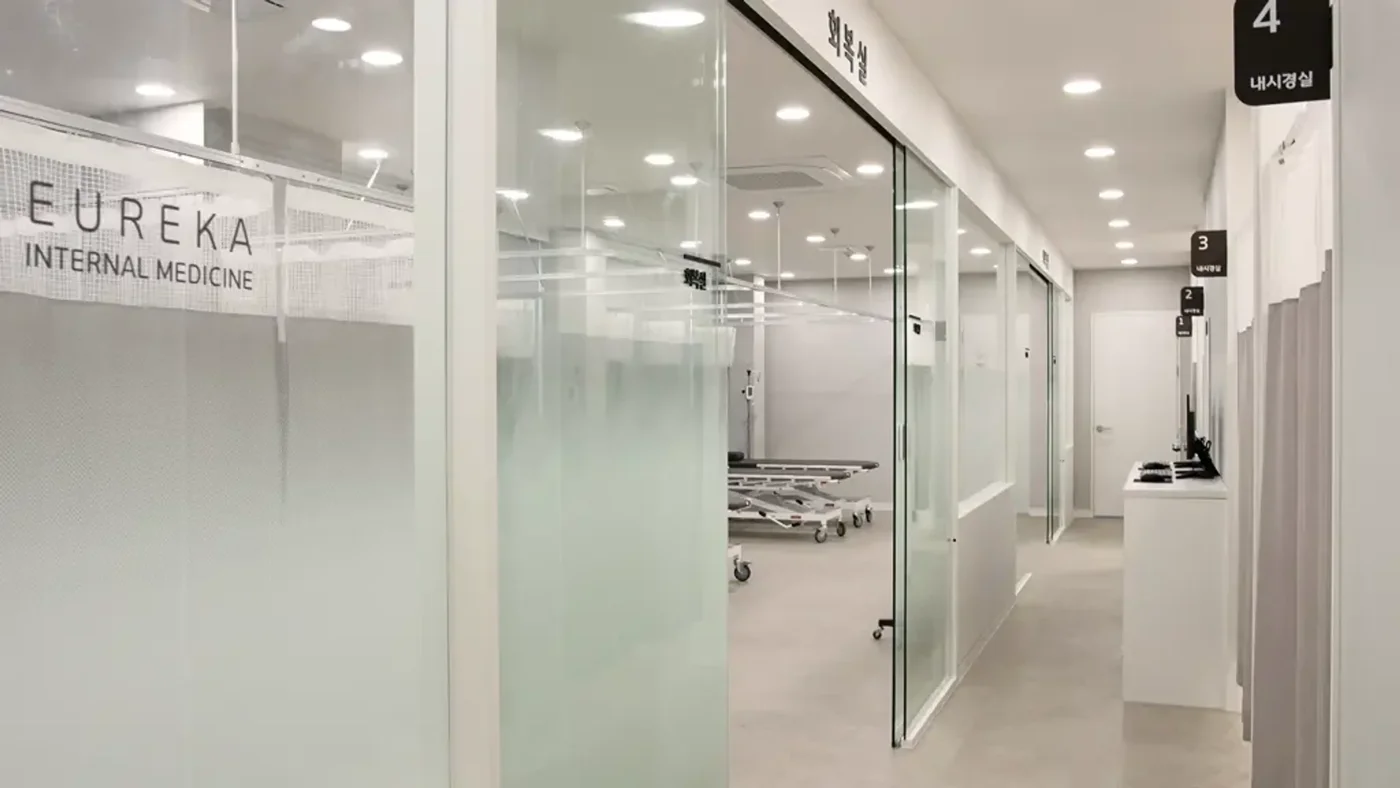 Suwon · Yeongtong
Eureka Internal Medicine & Health Checkup Centre
Internal medicine, endoscopy and imaging in Suwon, with four internal medicine specialists and a radiology specialist.
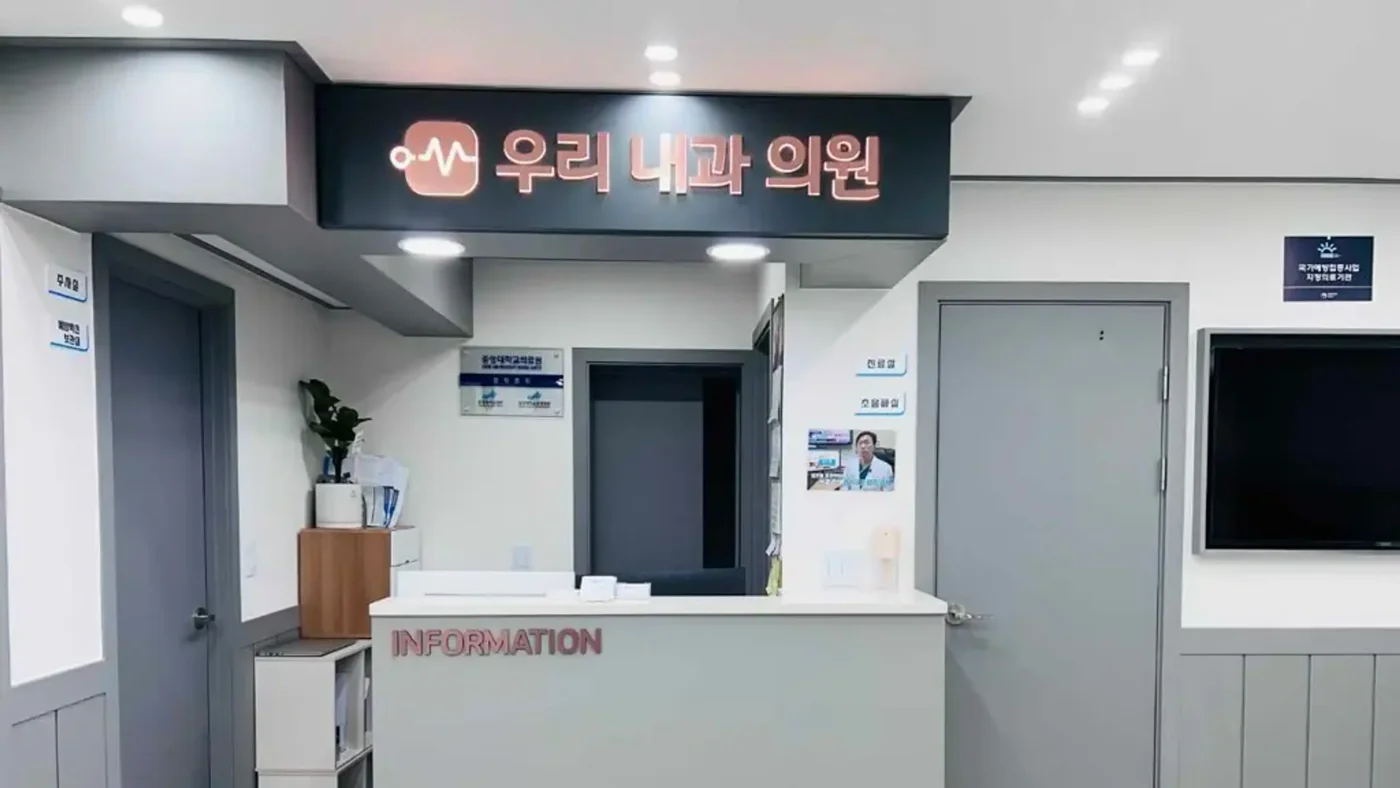 Seoul · Dongjak
Sangdo Woori Internal Medicine
Internal medicine consultations, blood and urine tests, thyroid assessment and chronic disease monitoring.
 Seoul · Seocho
Yonsei Clinic Seoul
Preventive care and chronic disease review with an internal medicine physician trained in nephrology.


Sources & further reading
- USPSTF: hypertension screening in adults ↗
- American Heart Association: when very high blood pressure needs urgent care ↗
- CDC: measuring your blood pressure ↗
- American Heart Association: home blood pressure monitoring ↗
- NICE: diagnosing and managing hypertension in adults ↗
- Korean Society of Hypertension: highlights of its 2026 guidelines ↗
- American Heart Association: 2025 high blood pressure guideline summary ↗
- Shrewsbury and Telford Hospital NHS Trust: ambulatory blood pressure monitoring ↗
- UK government: emergency services in South Korea ↗
- CDC: high blood pressure during pregnancy ↗
- Eureka Clinic: internal medicine and checkup follow-up ↗
- Sangdo Woori Internal Medicine: international website ↗
- Yonsei Clinic Seoul: Dr. Jae-ho Shin ↗
- CDC Yellow Book: continuity of care after medical travel ↗
Explore the partner centers
Use the directory to review relevant services and medical teams, then confirm the details directly with the provider.
Find a center