At a glance
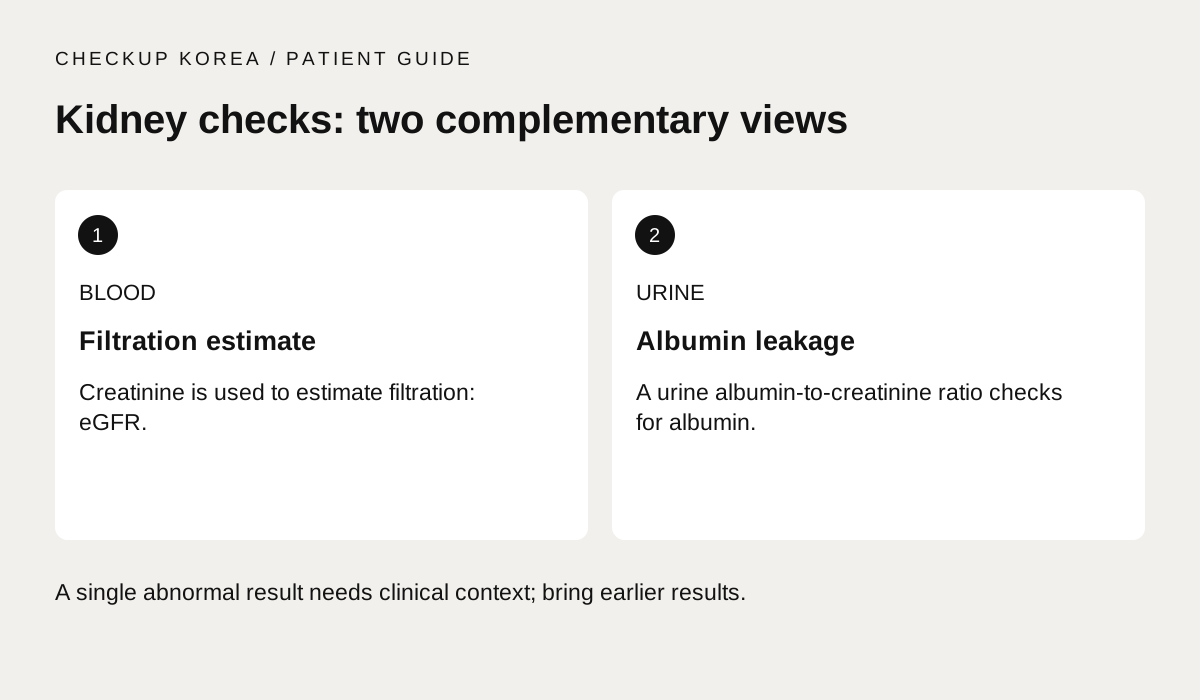
Kidney checks commonly combine an estimate of blood filtration, called eGFR, with a urine assessment for albumin. Ask which tests your Korean checkup includes and have a clinician interpret them together. One abnormal result may need prompt review and confirmation; it does not by itself establish chronic kidney disease.
Kidney testing answers two different questions
A kidney check usually needs more than one number. A blood test helps estimate how well the kidneys filter; a urine test can look for albumin, a protein that may appear in increased amounts when the kidneys are damaged. These are complementary pieces of information. A reassuring filtration estimate does not make the urine result irrelevant, and an abnormal urine result does not tell you its cause by itself.
If you are arranging a health checkup in Korea, ask what the package means by kidney function and urine testing. You may be comparing a general screening visit with a focused consultation about an earlier result. This guide explains the names you may see, the questions worth asking and how to organise a useful review without trying to diagnose yourself from a single flag.
Sources: NIDDK: identifying and evaluating chronic kidney disease; National Kidney Foundation: urine albumin-to-creatinine ratio
Who should discuss kidney checks with a clinician?
Diabetes, high blood pressure, cardiovascular disease and a family history of kidney failure are reasons to discuss kidney testing. NIDDK identifies these as risk factors for chronic kidney disease. The appropriate tests and frequency depend on your history; the benefit of screening every person in the general population is less clear. Buying extra tests simply because they are available is not the same as having a reason for them.
When you enquire, say whether you already have a kidney diagnosis, a previous abnormal result or a routine prevention question. Bring the original report if one exists. If you have symptoms or have recently been unwell, describe that first rather than booking only a standard checkup. The clinic needs enough information to decide which appointment fits your situation.
Sources: NIDDK: identifying and evaluating chronic kidney disease
Creatinine and eGFR: a measurement and an estimate
Creatinine is a waste product related to muscle activity that the kidneys remove from the blood. A laboratory can measure its concentration. Estimated glomerular filtration rate, usually written eGFR, is a calculation used to estimate filtration, commonly using blood creatinine along with other information. The two entries are related, but they are not interchangeable names for the same measurement.
The word estimated matters. Muscle size, diet and other circumstances can affect creatinine, so the calculated result needs context. Ask which result the doctor is using and whether anything about your health makes the estimate less dependable. Keep the units on the report when sharing it with a clinician overseas. An eGFR is not a simple percentage of kidney function, so do not read a result of 60 as meaning that exactly 60 percent of your kidneys remain.
Sources: National Kidney Foundation: estimated glomerular filtration rate; MedlinePlus: creatinine test
Urine albumin, urine protein and uACR are not identical
A general urine test may report protein, blood, glucose or other findings. A urine albumin-to-creatinine ratio, abbreviated uACR or UACR, specifically compares albumin with creatinine in the urine sample. The ratio helps account for how concentrated the urine is. Reports may use wording such as albumin/creatinine ratio, ACR or microalbumin creatinine ratio. Ask the laboratory or clinician to identify which measurement you actually received.
The practical booking question is whether a quantitative uACR is included when it is clinically appropriate, not simply whether a urine sample is collected. Do not assume that a general dipstick result supplies all the same information. If a package lists only urinalysis, ask the doctor whether that meets your needs or whether a more specific assessment is indicated. A test menu cannot answer that for an individual patient.
Sources: National Kidney Foundation: urine albumin-to-creatinine ratio; MedlinePlus: microalbumin creatinine ratio
One abnormal result does not establish chronic kidney disease
The KDIGO guideline cautions against assuming chronic disease from a single abnormal eGFR or urine albumin result. Previous measurements, medical history and repeat testing help establish whether a problem has persisted. Chronic kidney disease involves abnormalities present for at least three months, but that definition is not an instruction to wait three months before seeking an assessment. A recent change can require earlier attention.
Ask two separate questions: what needs to happen now, and what will establish the longer-term picture? The answer may involve reviewing older records, repeating a sample or arranging another investigation. Let the clinician set the timing. If you are returning home soon, write down who will arrange the next test and send the result to the reviewing doctor. Do not leave with only an instruction to repeat later.
Sources: KDIGO 2024 guideline: evaluation and management of chronic kidney disease
Prepare so the results can be interpreted fairly
Tell the clinic about medicines, supplements, recent illness and unusually strenuous exercise. Creatinine and urine albumin can be affected by circumstances other than chronic kidney damage. For example, exercise and fever can temporarily influence urine albumin. These details are useful context, not a reason to dismiss an abnormal result yourself. If you are menstruating or have urinary symptoms, ask whether this changes the collection plan.
Follow the instructions for your confirmed tests. A combined checkup may have food or fluid restrictions that differ from those for an isolated kidney blood test. Do not stop prescription medicines or change your fluid intake dramatically to try to improve a number. Ask how to collect the sample, whether an early-morning sample is preferred and what to do if you cannot provide it at the appointment. Report any preparation problem honestly.
Sources: MedlinePlus: creatinine test; National Kidney Foundation: urine albumin-to-creatinine ratio; MedlinePlus: microalbumin creatinine ratio
When would another blood test help?
Sometimes the clinician may consider cystatin C, another blood marker used to estimate filtration, or another way of assessing kidney function. MedlinePlus describes eGFR calculations using creatinine, cystatin C or both. Cystatin C can be helpful when creatinine does not provide a sufficiently dependable estimate. It is not automatically necessary for every checkup, and the choice should follow the clinical question.
Ask what uncertainty the additional test is intended to resolve. Would it change the interpretation, the follow-up interval or another decision? Also ask whether it can be performed locally, when the result will return and whether a second results consultation is included. You do not need to select the formula yourself. You do need to understand why another test is being proposed and what happens if its estimate differs from the first one.
Sources: MedlinePlus: eGFR and GFR tests
What happens during the blood and urine tests?
For a blood creatinine or cystatin C measurement, a healthcare professional usually takes a small blood sample from a vein. A brief sting and minor bruising are possible. A urine sample is generally collected separately in a labelled container. Tell staff if blood draws make you faint, and ask them to explain the collection instructions if the language is unfamiliar. These laboratory tests do not themselves involve a scan or sedation.
Check your identifying details on the sample label and confirm where to return the container. If the clinician has requested a timed collection rather than a single sample, ask for the complete written instructions before starting; the collection method matters. Do not substitute a sample brought from home without checking how it should be stored and transported. Before leaving the laboratory, ask when the results will be ready and how the clinical review will be arranged.
Sources: MedlinePlus: microalbumin creatinine ratio; MedlinePlus: eGFR and GFR tests
Reading a Korean checkup menu without assuming coverage
KDCA describes serum creatinine, eGFR and urine testing among the common items in Korea’s general national health screening programme. That description does not establish that every private package includes a quantitative urine albumin ratio, or that every international visitor qualifies for a national screening benefit. Treat programme eligibility, the contents of a private quote and the medical reason for a test as separate questions.
Ask the center to list the precise tests in English on your quotation, including whether a clinical interpretation is included. If you are using NHIS or an employer programme, confirm the covered items and any optional charges before agreeing to additions. If you are paying privately, request the total for the consultation, proposed laboratory work and results discussion. This article does not provide a verified kidney-testing price for partner clinics.
A listed clinic to consider for a kidney-focused discussion
Yonsei Clinic Seoul is a relevant partner to consider when a checkup raises a kidney question. Its published doctor biography identifies Dr. Jae-ho Shin as the clinic’s director and lists nephrology fellowship training at Gangnam Severance Hospital. The same biography includes kidney disease management, hypertension and proteinuria among his clinical areas. These provider-reported facts support a focused enquiry about an earlier kidney-related result; they are not an independent verification of licensure.
The clinic’s international website places it by Exit 7 of Seocho Station in Seoul. Review its Checkup Korea profile and the linked international website, then ask whether Dr. Shin can review your records and which laboratory tests are available for your concern. Confirm language arrangements, appointment availability and reporting times directly. This recommendation is based on the listed kidney-care scope, not a comparison of outcomes or a promise that a particular investigation will be offered.
Sources: Yonsei Clinic Seoul: Dr. Jae-ho Shin; Yonsei Clinic Seoul: international website
Bring a small, usable record bundle
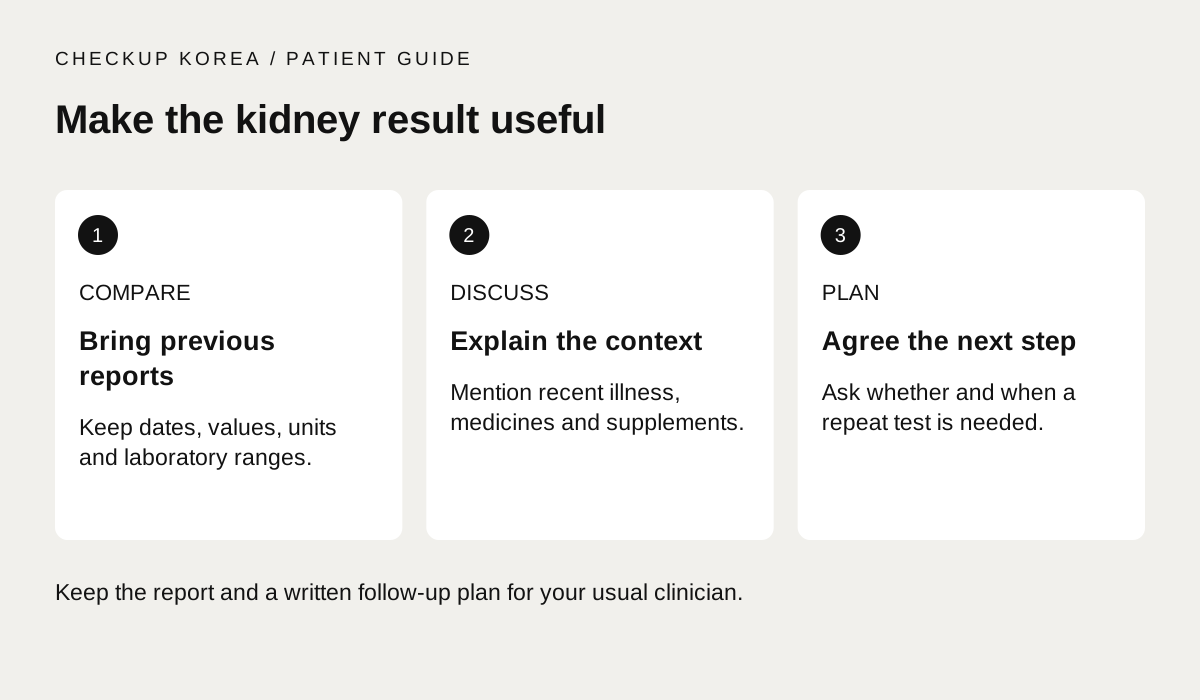
For a kidney consultation, organise earlier creatinine, eGFR and urine results in date order. Keep the laboratory name, units and reference information visible. Add your medicine list and relevant blood-pressure records if you have them. Preserve the original documents even if you prepare a short English summary. A table you transcribed yourself can help orient the discussion, but should not replace the underlying report.
Write down three questions you want answered: whether the finding is new, whether another test is needed, and who will manage follow-up. Ask the clinic for its secure route for sharing records rather than attaching medical information to an ordinary public enquiry. Before the appointment, check that files open on your phone without relying on a hotel connection or an expiring download link. This preparation helps a short consultation focus on decisions.
Sources: KDIGO 2024 guideline: evaluation and management of chronic kidney disease; CDC Yellow Book: medical tourism and continuity of care
Leave with a plan that works after your trip
A useful review ends with an explanation and a practical next step. Ask for copies of the final blood and urine reports, the clinician’s interpretation and any repeat-testing or referral recommendation. Record which items are still pending. If follow-up will take place outside Korea, tell the provider where you will be and ask what information your usual clinician should receive.
The CDC advises people receiving care abroad to obtain their medical records and plan continuity of care. Apply that to the actual kidney question: who reviews a repeat sample, who compares it with previous results and who explains any change in the plan? Confirm whether a remote discussion is available rather than assuming it is. If a result or symptom needs prompt attention, follow the clinician’s advice instead of postponing assessment to fit a flight or waiting for the next routine package.
Sources: CDC Yellow Book: medical tourism and continuity of care
Common questions
Does a normal eGFR mean my urine result does not matter?
No. Urine albumin can reveal a different aspect of kidney health, including when eGFR is preserved. Ask a clinician to interpret the blood and urine findings together.
Should I wait three months before discussing an abnormal result?
No. Three months relates to establishing chronicity, not a universal waiting period for care. Ask the clinician how soon you need assessment and repeat testing.
- Yonsei Clinic Seoul profile
- Dr. Jae-ho Shin profile
- General health checkups and their limits
- Understanding checkup results and follow-up
- Visitor and resident screening arrangements
Contact the relevant partners
Yonsei Clinic Seoul international website
Dr. Jae-ho Shin’s official biography
Partner centers to explore
These centers list related services. Confirm the exact examination and appointment with the center.
 Seoul · Seocho
Yonsei Clinic Seoul
Preventive care and chronic disease review with an internal medicine physician trained in nephrology.

Sources & further reading
- NIDDK: identifying and evaluating chronic kidney disease ↗
- National Kidney Foundation: estimated glomerular filtration rate ↗
- MedlinePlus: creatinine test ↗
- National Kidney Foundation: urine albumin-to-creatinine ratio ↗
- KDIGO 2024 guideline: evaluation and management of chronic kidney disease ↗
- MedlinePlus: microalbumin creatinine ratio ↗
- MedlinePlus: eGFR and GFR tests ↗
- Yonsei Clinic Seoul: Dr. Jae-ho Shin ↗
- Yonsei Clinic Seoul: international website ↗
- KDCA: national health screening information ↗
- CDC Yellow Book: medical tourism and continuity of care ↗
Explore the partner centers
Use the directory to review relevant services and medical teams, then confirm the details directly with the provider.
Find a center